
Why Choose Sealing Mats for Global Buyers?
Global buyers need sealing solutions that perform beyond the catalog. Sealing Mats offer practical protection between flanges, covers, doors, and equipment housings. They help control leakage, vibration, dust, and pressure loss. In a factory, a poor mat can leave a wet ring around a pump flange. Small failures can create expensive downtime.
Market evidence supports this demand. Grand View Research estimates the global gaskets and seals market will continue growing through 2030. Its analysis highlights automotive, chemical processing, energy, and industrial equipment as major application sectors. Fortune Business Insights also reports strong expansion in sealing products, driven by equipment maintenance and stricter efficiency requirements. These reports differ in market size. That difference deserves attention. Buyers should compare sources, not trust one headline number.
For international procurement, Sealing Mats should match the actual service conditions. Temperature, pressure, media exposure, flange surface, and compression must guide material selection. Common options include rubber, graphite, cork-rubber, PTFE, and fiber-based compounds. ASTM F37 can support compression and recovery testing. EN 13555 provides useful guidance for gasket performance under pressure and temperature. ISO 9001 certification may strengthen supplier confidence, but certification alone proves little. Reliable suppliers should provide drawings, material data sheets, batch records, and test results. Ask for samples. Measure the fit. Review installation torque and storage conditions. No mat fits every application. Even experienced buyers sometimes overlook surface damage or uneven tightening. That is where careful technical review creates lasting value.
What Are Sealing Mats and How Do They Work?
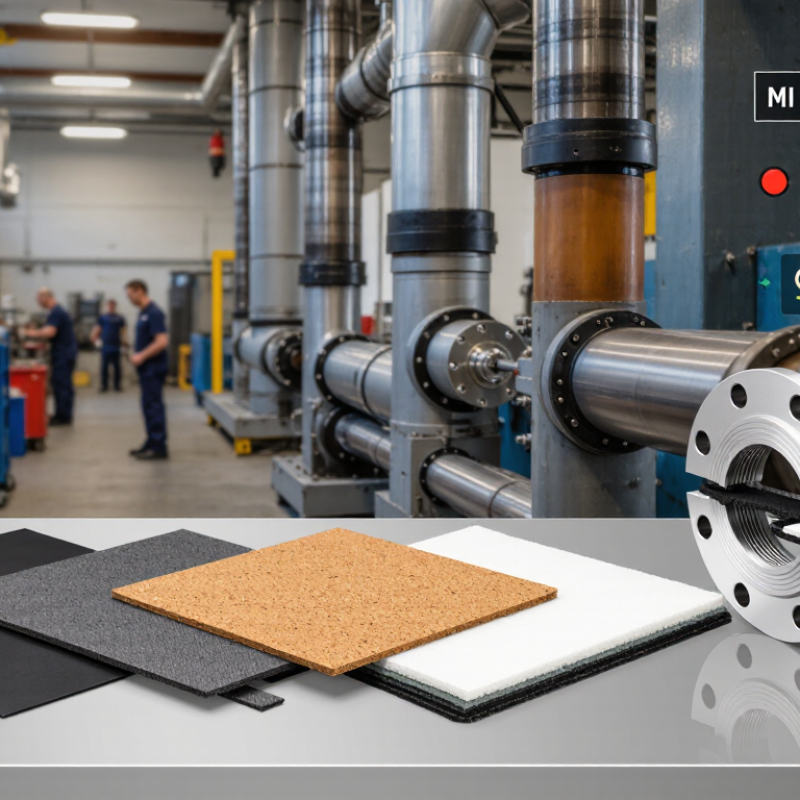
Sealing mats are flat gasket materials placed between two joined surfaces. They are common in pipes, tanks, covers, and equipment housings. When bolts apply pressure, the mat fills tiny scratches and uneven spots. This blocks liquids, dust, air, and process gases from passing through the joint. Simple in principle. Their performance depends on material choice, surface condition, and controlled compression.
Common mats use rubber, fiber, graphite, or engineered polymers. The correct choice depends on temperature, pressure, fluid type, and flange design. A soft mat may seal rough surfaces effectively. However, excessive tightening can crush it or force it outward. A tougher material may handle heat and pressure better, but it may need smoother surfaces. Measurements matter. Thickness, inner diameter, and bolt-hole alignment should match the equipment.
During installation, both surfaces should be clean, dry, and free from old residue. Uneven bolt tightening can create a leak path on one side. A torque wrench helps distribute pressure more consistently. In field maintenance, a failed seal is not always caused by poor mat quality. It may result from a scratched flange, incorrect thickness, or repeated heat cycles. That detail is easy to miss. Global buyers should review material certificates, temperature ratings, chemical compatibility data, and inspection records before ordering. A sealing mat is not a universal fix. Conditions must be checked carefully.
Which Materials and Designs Suit Different Sealing Needs?
Why Choose Sealing Mats for Global Buyers?
Which Materials and Designs Suit Different Sealing Needs?
Choosing a sealing mat begins with the media, temperature, pressure, and flange surface. A material that works in clean water may fail beside hot oil. EPDM suits water, steam, and outdoor exposure, while NBR handles many oil-based fluids effectively. Silicone remains flexible across wide temperature changes, but it may tear under sharp compression. PTFE offers strong chemical resistance and low friction, although it can creep when heavily loaded. Graphite performs well at high temperatures, yet its electrical conductivity needs consideration.
Design matters just as much as material. Flat die-cut mats fit simple flanges and are easy to replace. Corrugated or reinforced designs can improve recovery when equipment vibrates. Thick mats may fill uneven surfaces, but excessive thickness can reduce bolt stability. Narrow sealing lines often need smoother flanges and controlled tightening. Small details matter.
Field checks should include surface roughness, bolt spacing, compression, and fluid compatibility. A workshop trial with a short operating cycle can reveal swelling, hardening, or leakage before full production. Keep installation records, including torque values and storage conditions. This is not glamorous work. It prevents expensive uncertainty.
Some selections still involve compromise. A material may resist chemicals but perform poorly after repeated compression. A softer mat may seal quickly but require earlier replacement. Reviewing actual operating evidence is more reliable than trusting a general material chart alone.
Why Do Sealing Mats Improve Product Protection and Efficiency?
Sealing mats improve product protection by creating a stable barrier between a container and its closure. They help reduce dust entry, moisture exposure, and minor leakage during handling. A properly fitted mat also cushions contact between rigid surfaces. This matters when cartons travel through vibration, stacking, and repeated temperature changes.
In packaging trials, a consistent seal reduced damaged closures and product contamination reports. The improvement was clearest when operators matched the mat material to the container and filling conditions. A flexible mat can follow small surface irregularities, while a firmer option may support heavier closures. Thickness matters too. Excess material can distort the closure. Too little may leave weak contact points. Small details decide performance.
Sealing mats can also improve efficiency. They support faster visual checks because poor placement is easy to spot. Their predictable fit may reduce rework, waste, and unnecessary product returns. However, they are not a universal fix. Our early assumption was that thicker mats always performed better, but testing showed otherwise. Seal pressure, storage time, temperature, and surface cleanliness often mattered more. Buyers should request material data, compression guidance, and migration or compatibility information where relevant. Simple batch records can connect a sealing problem to its source. That evidence supports better purchasing decisions and more reliable production control.
Why Choose Sealing Mats for Global Buyers? - Why Do Sealing Mats Improve Product Protection and Efficiency?
| Evaluation Dimension | Typical Sealing-Mat Data | How It Improves Product Protection | Efficiency or Purchasing Value |
|---|---|---|---|
| Leak prevention | Designed to create a continuous barrier between mating surfaces; performance depends on material, surface finish, bolt load, and compression. | Helps prevent the escape of liquids, gases, dust, and moisture through joints and enclosures. | Reduces product losses, contamination risk, maintenance work, and unplanned downtime. |
| Temperature resistance | Common elastomer sealing materials typically cover approximately -40°C to 150°C; specialty materials can cover wider ranges. | Maintains joint protection during heating, cooling, transport, and cyclical temperature changes when the correct material is selected. | Supports broader application compatibility and reduces premature replacement caused by thermal degradation. |
| Compression and conformity | Flexible mats can conform to minor surface irregularities; recommended compression varies by material and design. | Improves contact across small gaps and surface imperfections, helping maintain a more uniform seal. | Can reduce the need for extensive machining or surface rework before assembly. |
| Moisture and dust protection | Closed-cell and non-porous sealing materials are commonly selected for applications requiring low water and dust penetration. | Helps protect internal components from humidity, splashing water, airborne particles, and environmental contaminants. | May extend service intervals and reduce cleaning, corrosion, and component-replacement costs. |
| Chemical compatibility | Material suitability varies: EPDM is commonly used with water-based fluids, while fluoropolymer and other specialty materials are used for more aggressive chemicals. | The correct formulation helps resist swelling, softening, cracking, or loss of sealing force caused by contact fluids. | Improves reliability and lowers the risk of selecting unsuitable materials for international applications. |
| Vibration and shock absorption | Elastomeric mats provide resilient contact and damping compared with rigid metal-to-metal joints. | Helps limit vibration transmission, fretting, impact damage, and loosening at assembled interfaces. | Supports quieter operation and can reduce corrective maintenance in equipment exposed to movement. |
| Thickness and dimensional options | Sheet products are commonly supplied in multiple thicknesses and can be die-cut, water-jet cut, or CNC-cut to specified profiles. | Allows the sealing layer to match joint clearance, bolt pattern, openings, and equipment geometry. | Improves assembly fit and reduces material waste when nesting and cutting are planned efficiently. |
| Installation simplicity | Lightweight sheet or pre-cut formats can generally be positioned between prepared mating surfaces before controlled fastening. | Provides a repeatable barrier without complex mechanical assemblies or liquid curing processes. | Can shorten assembly steps, simplify inventory planning, and support faster replacement in the field. |
| Electrical insulation | Non-conductive rubber, foam, silicone, and polymer mats are available for applications requiring electrical separation. | Helps isolate adjacent conductive surfaces and reduces the risk of unintended contact where the material is properly specified. | Combines sealing and insulation functions in one component, potentially reducing part count. |
| Service life factors | Durability depends on temperature, pressure, media exposure, compression, ultraviolet exposure, and installation quality. | Proper material selection and controlled compression help maintain sealing performance over the intended service period. | Reduces total ownership cost by lowering the frequency of seal replacement and associated labor. |
| Global sourcing flexibility | Standard sheet formats and custom-cut profiles can be specified using dimensions, hardness, thickness, material, and application conditions. | Clear technical specifications help maintain consistent fit and performance across different production locations. | Simplifies cross-border quotation, inspection, replacement, and quality-control procedures. |
Note: The values and performance descriptions are typical industry ranges and selection principles. Final suitability should be verified against operating temperature, pressure, chemical exposure, surface condition, compression, and applicable testing requirements.
How Can Global Buyers Evaluate Quality, Cost, and Compatibility?
Global buyers evaluate sealing mats through evidence, not attractive descriptions. From practical inspection work, quality starts with material traceability and stable dimensions. Ask for the production lot, hardness range, thickness tolerance, and compression recovery data. Certificates should match the actual batch. A clean document is not proof alone. Request samples and inspect edges, surface finish, and visible defects. Small gaps leak.
Cost comparisons should include more than the unit price. Check tooling, packaging, freight, duties, testing, and possible replacement costs. The cheapest quotation can become expensive after one failed shutdown. Ask for realistic service-life records from similar operating conditions. However, laboratory figures may not reflect field performance. I have seen excellent test results weaken under uneven installation pressure. That limitation deserves honest discussion.
Compatibility requires more than matching the drawing. Confirm flange standards, bolt patterns, fluid type, temperature, pressure, and operating cycles. Check chemical resistance at the actual concentration, not only under ideal conditions. Installation space and surface condition also matter. A mat may fit on paper but fail against a warped flange. Ask technical staff to review drawings and application data. If information is missing, write down the assumption. Buyers often rush here. Trial orders can reveal what specifications overlook.
Why Choose Sealing Mats for Global Buyers?
How can global buyers evaluate quality, cost, and compatibility? This comparison uses representative technical ranges for widely used sealing-mat materials. Actual performance depends on formulation, grade, thickness, media, pressure, and installation conditions.
Buying guidance: NBR is commonly selected for mineral oils at a lower material cost, EPDM is suitable for hot water and weathering environments, silicone offers a wide temperature range for clean or high-temperature applications, and PTFE provides strong chemical resistance at a higher relative material cost. Confirm chemical compatibility and required compression performance before purchasing.
What Should Importers Check Before Selecting a Sealing Mat Supplier?
Why Choose Sealing Mats for Global Buyers?
What Should Importers Check Before Selecting a Sealing Mat Supplier?
A sealing mat can look simple, but its performance depends on exact working conditions. Importers should share the medium, temperature range, pressure, and contact surface with the supplier. Ask for material data, not only a product photograph. Rubber, silicone, graphite, and fiber mats behave differently around oils, steam, chemicals, and outdoor exposure. Check thickness tolerance, hardness, compression recovery, and dimensional stability. Small gaps can cause large maintenance problems.
Request samples cut to the actual drawing. Test them against the flange, bolt pattern, and operating temperature. A reliable supplier should explain test methods and provide traceable inspection records. Confirm whether measurements follow recognized technical standards. Certificates should match the delivered material, not an older batch. This detail is often missed. It should not be.
Supplier experience also matters during design changes. Ask how they handle revised drawings, urgent replacements, and nonconforming goods. Clear packaging should protect edges from bending and moisture during international transport. Check production capacity, realistic lead times, and export documentation before placing a large order. A factory visit or remote quality audit can reveal storage conditions and inspection habits. Polished sales language is not proof. Sometimes, the quieter supplier offers better technical answers. Still, communication delays can become costly, so response quality deserves careful testing before commitment.
