
China Top 10 Plastic Utensils Manufacturers
China’s Plastic Utensils industry combines large-scale production with increasingly careful material control. From injection molding workshops to automated packing lines, manufacturers serve restaurants, retailers, airlines, and food-service distributors worldwide.
This guide examines ten leading Chinese manufacturers through practical purchasing criteria. The review considers product range, production capacity, tooling experience, quality systems, export performance, and food-contact documentation. It also checks whether suppliers provide traceable resin information, stable dimensions, clean edges, and reliable packaging. These details matter when a spoon must survive a busy buffet line or a fork must resist cracking beside hot food.
Chris DeArmitt, PhD, a recognized plastics materials expert, has stated, “Plastic is not the problem; waste is the problem.” His comment offers useful perspective for evaluating Plastic Utensils manufacturers. A responsible supplier should explain material choices, production waste controls, and realistic end-of-life options. Claims about sustainability deserve evidence, not attractive slogans.
No ranking is flawless. Supplier strengths change with equipment upgrades, regulations, and market demand. Some companies publish limited factory information, which makes comparison difficult. Therefore, this introduction treats the list as a research starting point rather than a final verdict. Buyers should request samples, audit certificates, test reports, and current quotations before signing contracts. Small checks reveal large differences. A polished catalog cannot replace production evidence, consistent inspection, and clear communication.
Definition and Scope of Plastic Utensils Manufacturing in China
Plastic utensils manufacturing in China covers the design, production, inspection, and distribution of tools made mainly from polymer materials. These products include forks, spoons, knives, tongs, spatulas, ladles, measuring tools, and food preparation accessories. The category includes both single-use and reusable items. It usually excludes plastic packaging, storage containers, and medical instruments unless they serve a direct utensil function.
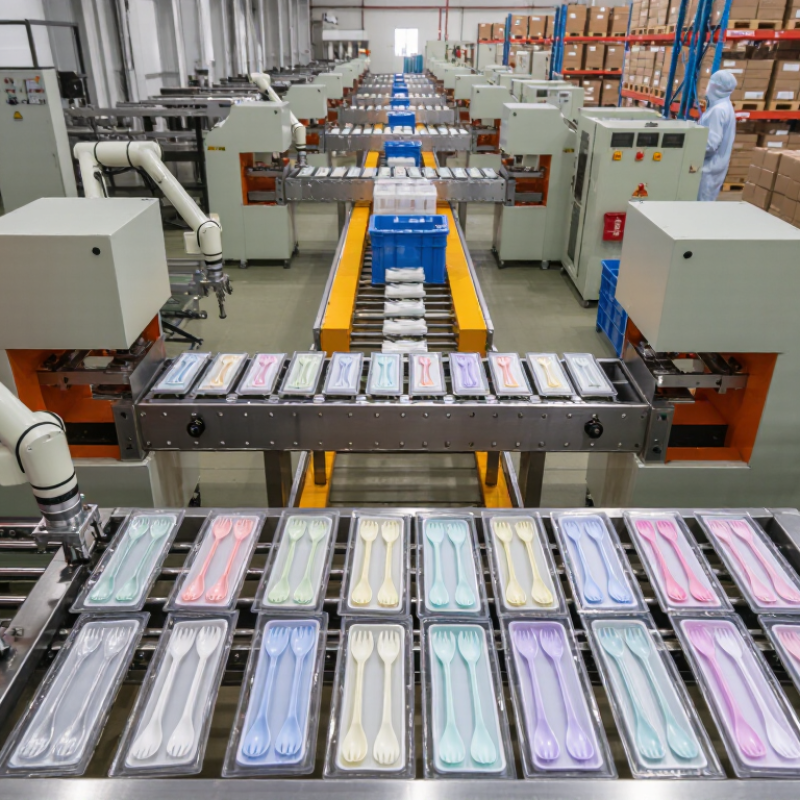
Manufacturers commonly work with polypropylene, polyethylene, polystyrene, and food-contact-grade engineering plastics. Material selection depends on heat resistance, flexibility, strength, appearance, and intended use. Injection molding remains the dominant process for high-volume production. Some factories also use extrusion, ultrasonic welding, printing, and automated assembly.
Factory evaluations should examine mold accuracy, material traceability, hygiene controls, dimensional checks, and batch records. Small details matter, such as smooth edges and clean handle joints.
The scope also includes product development and export preparation. Engineers may create prototypes, adjust wall thickness, and test utensils under hot, cold, oily, or acidic food conditions. Compliance requirements differ across markets, so reliable suppliers maintain suitable testing documents and production controls.
The boundary is not always clean. A serving scoop may be classified as a utensil, while a storage scoop may follow another product category. Buyers should define the application, material, packaging, and testing expectations in writing. A practical definition can still be imperfect. That is why regular inspections remain valuable.
Criteria for Selecting the Top 10 Chinese Manufacturers
China Top 10 Plastic Utensils Manufacturers
Selecting the top ten Chinese plastic utensils manufacturers requires more than comparing online catalogs. A reliable evaluation begins with factory verification. Review production licenses, quality certificates, and food-contact testing reports. Check whether documents match the actual factory and material supplied. A video call is useful, but an on-site audit provides stronger evidence.
Material control deserves close attention. Ask for resin specifications, colorant details, and batch traceability records. During sampling, inspect fork tips, spoon edges, wall thickness, and surface finish. Uneven edges can indicate poor mold maintenance. Independent migration testing should confirm compliance with the destination market’s requirements. Do not rely only on a supplier’s internal report.
Production capacity must also match the order plan. Examine injection machines, mold maintenance routines, packaging lines, and inspection points. Ask how defects are recorded and corrected. A capable manufacturer should explain lead times with real production data, not vague promises. Communication matters too. Clear drawings, sample approvals, and written change controls reduce costly misunderstandings. Sustainability claims need evidence, such as recycled-content records or waste-reduction data. These points are practical, but no scoring model is perfect. A small factory may offer careful service, while a larger one may provide better stability. Trial orders reveal more than impressive presentations. Inspect the cartons, count the pieces, and document every variation.
Profiles of China’s Top 10 Plastic Utensils Manufacturers
China Top 10 Plastic Utensils Manufacturers
Profiles of China’s Top 10 Plastic Utensils Manufacturers
China’s leading plastic utensil manufacturers differ in equipment, materials, and quality systems. A useful profile should examine more than production volume. It should include factory location, molding methods, export experience, and inspection procedures. Some manufacturers focus on reusable kitchen tools, while others produce disposable spoons, forks, and serving sets. Their product ranges often include polypropylene, polyethylene, and food-contact silicone components. Material selection affects heat resistance, flexibility, and cleaning performance.
One manufacturer may specialize in high-speed injection molding for large orders. Another may offer smaller batches with flexible color matching. A third may produce travel utensils with compact, nested designs. Several facilities support custom molds, but tooling fees and development times can vary sharply. Some maintain automated visual inspection, while others still rely heavily on trained workers. That difference deserves attention. It can influence consistency between production lots.
The strongest profiles also review documentation, sample approval, and traceability practices. Buyers should request food-contact test reports from recognized laboratories and verify their scope. A factory with modern machinery is not automatically a reliable supplier. Production records, packaging control, and corrective-action procedures matter just as much. One manufacturer may communicate quickly but provide limited technical evidence. Another may be slower yet more transparent. These profiles are practical sourcing references, not permanent rankings. Factory conditions can change, and published information may remain incomplete. On-site audits and independent testing are still necessary.
Product Types, Materials, and Manufacturing Capabilities
China Top 10 Plastic Utensils Manufacturers
China’s leading plastic utensil manufacturers serve foodservice, retail, catering, and institutional buyers. Their product ranges often include forks, spoons, knives, stirrers, trays, cups, lids, and portion containers. Common materials include PP, PS, PET, and food-contact grades of recycled or bio-based polymers. Each material changes stiffness, transparency, heat resistance, and cost.
Manufacturing capability matters more than a large catalogue. Strong suppliers usually operate injection molding, thermoforming, extrusion, automatic assembly, and optical inspection lines. They may also provide custom molds, color matching, logo printing, sealed packaging, and export documentation. The OECD Global Plastics Outlook reported that 353 million tonnes of plastic waste were generated worldwide in 2019, while only 9% was recycled. This makes material traceability and recycled-content verification increasingly important. Claims still need checking.
Tips: Ask for resin certificates, migration-test reports, production samples, and mold-life records. Confirm whether “compostable” means industrially compostable or home compostable. The difference is significant. Also compare cycle time, defect rates, and carton loading, not only unit price. A low quotation can hide weak quality control. Suppliers should explain how they manage sharp edges, warping, contamination, and batch variation. The ranking is never perfect. Factory audits and recent samples remain essential.
China Top 10 Plastic Utensils Manufacturers: Product Types, Materials, and Manufacturing Capabilities
The chart summarizes commonly reported capabilities across a representative group of ten Chinese plastic utensil manufacturers. Reusable tableware and disposable food-service products are the most widely offered categories, while PP and PS are the most frequently used materials. Injection molding is the dominant manufacturing process, supported by custom tooling, color matching, and private-label production.
Quality Standards, Certifications, and Global Sourcing Considerations
When comparing China’s top ten plastic utensil manufacturers, quality evidence should come before price. The Plastics Europe Plastics—The Fast Facts 2024 report recorded 413.8 million tonnes of global plastics production in 2023. This scale makes material control essential. Ask suppliers for resin specifications, food-contact declarations, and batch-level traceability. ISO 9001 supports process consistency, while ISO 14001 indicates structured environmental management. Neither certificate guarantees safe utensils.
For food-contact products, request migration testing from an accredited laboratory. Tests should match the intended food, temperature, and contact duration. Requirements may differ between China, the European Union, and the United States. European Regulation (EU) No 10/2011 covers plastic food-contact materials, while US food-contact rules apply through relevant federal provisions. Check declarations carefully. A copied certificate is not enough. Production samples should match tested materials, colors, and additives.
Global sourcing also requires environmental scrutiny. The OECD Global Plastics Outlook reported that only 9% of plastic waste was recycled in 2019. Recycled content therefore needs verified origin, controlled contamination, and clear percentage claims. During factory audits, inspect drying areas, mold cleanliness, metal detection, packaging storage, and complaint records. Small details matter. One weakness remains: remote audits can miss real production behavior. Request recent batch videos, unannounced inspection rights, and independent pre-shipment testing before approving large orders.
| No. | Anonymous Manufacturer Profile | Typical Product Scope | Common Materials | Relevant Quality Standards and Regulations | Evidence Buyers Should Request | Global Sourcing Considerations |
|---|---|---|---|---|---|---|
| 1 | Food-Contact Injection Molding Profile High-volume general-purpose utensil producer | Forks, spoons, knives, serving tools and reusable kitchen utensils | PP, PS, ABS, SAN and food-contact nylon, subject to the intended application | EU 1935/2004 EU 10/2011 FDA 21 CFR GB 4806.7-2023 | Material declaration, supplier lot records, migration-test reports, incoming inspection records and process-control documentation | Confirm the exact polymer grade, food-contact limitations, temperature range, colorant compliance and traceability from resin lot to finished shipment |
| 2 | Reusable Premium Utensil Profile Producer focused on durable consumer products | Reusable cutlery sets, travel utensils, lunchbox accessories and premium serving pieces | PP, Tritan-type copolyesters, stainless-steel-reinforced plastics and silicone components | ISO 9001 EU 10/2011 FDA food-contact rules REACH | Dimensional inspection plan, dishwasher-cycle data, impact testing, odor testing and documented corrective-action procedures | Evaluate product life, repeated-wash performance, spare-part requirements, packaging durability and warranty-handling capability |
| 3 | Disposable Catering Utensil Profile Large-scale foodservice supplier | Single-use forks, spoons, knives, stirrers and catering cutlery kits | PP, PS, PET and other legally permitted food-contact polymers | Food-contact migration testing ISO 9001 BRCGS Packaging Materials GMP controls | Production-capacity statement, hygiene records, metal-detector checks where applicable, carton specifications and batch-retention policy | Check destination-country restrictions on single-use plastics, pack-count accuracy, pallet configuration, lead time and seasonal capacity |
| 4 | Thermoformed Utensil Profile Specialist in thin-wall and lightweight products | Lightweight cutlery, tasting spoons, trays, portioning tools and promotional utensils | PS, PET, PP and recyclable sheet-based materials | ISO 9001 EU 10/2011 FDA 21 CFR Applicable packaging rules | Sheet-thickness data, forming-temperature controls, trim-loss records, dimensional reports and visual-defect standards | Review stiffness, edge sharpness, nesting efficiency, transport volume, minimum order quantity and tooling ownership terms |
| 5 | Private-Label Customization Profile OEM/ODM supplier with decoration capability | Customized utensils, logo-printed sets, color-matched products and retail-ready kits | PP, ABS, PC-free copolyesters, silicone and approved masterbatch systems | ISO 9001 Food-contact compliance REACH Social-audit programs | Color-control records, artwork approval process, print-ink compliance documents, pre-production samples and inspection reports | Define intellectual-property ownership, approved-color tolerances, mold charges, artwork rights, packaging language and change-control procedures |
| 6 | Recycled-Content Utensil Profile Supplier offering recycled-resin options | Reusable utensils, non-critical serving tools and products designed around recycled-content targets | Post-consumer or post-industrial recycled PP, PET or other permitted polymers | ISO 14001 ISO 9001 GRS where applicable Destination-market rules | Chain-of-custody records, recycled-content percentage, contaminant-control data, food-contact suitability evidence and mass-balance explanation if used | Verify whether recycled resin is legally permitted for the intended food-contact use and whether the claim is supported by an accepted certification system |
| 7 | Compostable-Claim Product Profile Supplier using certified compostable materials | Single-use forks, spoons, knives, stirrers and foodservice accessories marketed for composting systems | PLA, PHA, molded fiber or other materials designed for specific composting conditions | EN 13432 ASTM D6400 ASTM D6868 Local labeling laws | Valid certification scope, disintegration and biodegradation test reports, authorized logo-use evidence and industrial-composting limitations | Never equate “biodegradable” with “compostable”; confirm whether the destination has industrial composting infrastructure and permitted labeling language |
| 8 | High-Precision Technical Profile Manufacturer serving demanding dimensional applications | Measuring spoons, dosing tools, laboratory-style utensils and precision-molded accessories | Engineering polymers such as POM, PA, PC-free copolyesters or application-approved PP | ISO 9001 ISO 13485 if applicable Food-contact rules when relevant RoHS where applicable | Gauge repeatability data, capability studies, calibration certificates, dimensional control plans and material certificates | Specify tolerances, measurement methods, sampling levels, mold-maintenance responsibilities and validation requirements before mass production |
| 9 | Integrated Packaging-and-Utensil Profile Supplier combining utensils with retail or foodservice packing | Cutlery kits, individually wrapped utensils, napkin sets and meal-delivery accessories | PP, PS, PET, paperboard, paper and approved flexible packaging materials | ISO 9001 BRCGS Packaging Materials EU food-contact framework FDA requirements | Packaging specifications, seal-integrity tests, hygiene zoning, artwork approvals, foreign-material controls and finished-pack inspections | Assess packing speed, carton optimization, multilingual labeling, barcode verification, mixed-SKU control and container-loading efficiency |
| 10 | Export-Ready Compliance Profile Supplier structured for multi-market procurement | Mixed portfolios of disposable and reusable plastic utensils for international buyers | Application-specific food-contact polymers selected for the target market | ISO 9001 ISO 14001 REACH EU, U.S. and China food-contact requirements | Factory audit access, test-report authenticity, certificate validity, product liability coverage, export references and documented complaint handling | Compare Incoterms, payment terms, inspection rights, production lead time, port options, customs documentation and business-continuity planning |
